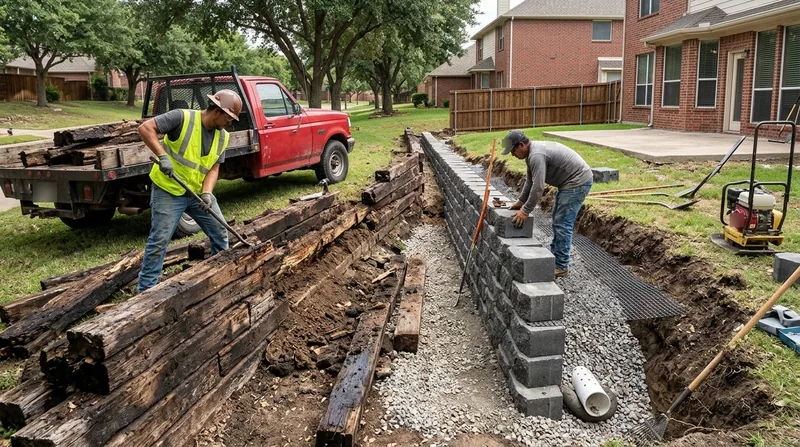




Railroad Tie Wall Replacement in Plano is a job we run every month in the older neighborhoods east of US 75, where 1980s and 90s ties are now rotting, bowing, and pushing out of line. Plano sits on Blackland Prairie clay that shrinks hard in August drought and swells under spring storms, and that movement is what kills creosote ties first. Around Downtown Plano, Hunters Glen, and Gleneagles, we pull tie walls that have leaned 6 to 10 inches into a backyard or dropped a course behind a pool deck. We tear out the old ties, haul the creosote lumber away, rebuild the drainage, and set a new wall in segmental block, concrete, or natural stone that will hold up to North Texas sun and flash runoff. If your wall is already leaning or collapsed, start with leaning and collapsed wall repair before the next rain season moves it further.
Why Railroad Tie Walls Fail Faster in Plano Than Anywhere Else on the Prairie
Most tie walls in Plano went in between 1980 and 1998, when creosote-treated railroad ties were the cheap answer for a creek-lot backyard or a driveway cut. Forty years of Blackland Prairie clay cycling under them has done the damage. The ties absorb groundwater, the clay swells, the wall rotates forward, and the tie ends rot out at the soil line. We see this constantly on the wooded lots along Spring Creek and Rowlett Creek, and in the steeper draws near Arbor Hills and Oak Point Park.
- Creosote ties rot from the inside out, so the wall looks solid until a course suddenly drops.
- Expansive clay pushes the base course forward and opens gaps behind the wall.
- Original tie walls rarely had gravel backfill or a perforated drain, so water ponds behind them.
- Summer sun dries and splits the tie faces, and the splits hold water through the next storm.
- Hollow or collapsed tie walls near a pool, driveway, or foundation become a real safety issue.
Once a tie wall has rotated more than a few inches, patching it is money thrown away. The fix is removal and a rebuild with proper drainage.
Key info: A tie wall behind a Willow Bend pool deck or a Legacy-area driveway carries a surcharge load. When a wall holds up a driveway or structure, Plano's building department may require a permit and engineered drawings, so we verify the threshold with the city before we demo anything.
For the permit side, the City of Plano's building department is the authority on wall height, surcharge, and setback rules. You can check current requirements at the City of Plano official site before you schedule work.
How We Replace a Railroad Tie Wall in Plano, Step by Step
We do not build a new wall on top of old ties or old clay. The rebuild starts with a clean excavation, because the drainage is what makes the new wall last. On a typical Hunters Glen or Gleneagles job, we pull the ties, dig out the failed clay, and reset the base on compacted gravel before a single block goes down.
- We walk the wall with you and mark the property line, utilities, and any HOA setback rules.
- We remove the creosote ties and haul them off site, since treated railroad lumber does not go in a standard curbside bin.
- We excavate the failed clay and cut a level trench for a compacted gravel footing.
- We install perforated drain pipe, filter fabric, and washed gravel backfill so water leaves the wall.
- We set the new wall in segmental block, poured concrete, or natural stone, course by course, with proper batter.
- We compact the backfill, restore the grade, and clean the site before we leave.
Every rebuild gets a drainage system, because a wall without one fails the same way the old ties did.
Local example: On a creek-lot wall off Russell Creek in west Plano, the old ties had rotted through and the clay behind them was saturated. We replaced 42 feet of tie wall with a segmental block wall on a gravel footing, added drain pipe and gravel backfill, and tied the new wall into the existing grade so runoff no longer ponds at the neighbor's fence line.
If the wall sits on a slope above a creek or a retaining structure, we pair the rebuild with slope stabilization and erosion control so the ground behind it stops moving.
Rebuild Options: What Replaces an Old Railroad Tie Wall
Once the ties are out, you have real choices. The right one depends on wall height, what the wall is holding back, and how the yard is used. We quote each option on site so you can compare them on the same wall.
| Approach | Description | Best for |
|---|---|---|
| Segmental block | Interlocking block with gravel backfill and drain pipe, built course by course. | Most backyard and creek-lot tie wall replacements in Plano. |
| Poured concrete | Formed and poured wall with rebar and a drained footing. | Driveway cuts, pool decks, and walls carrying a surcharge. |
| Natural stone or boulder | Chopped limestone or stacked fieldstone set on a gravel base. | Visible garden walls and landscape beds in older Plano yards. |
| New timber wall | Pressure-treated landscape timbers on a gravel footing, with drainage. | Low garden walls where budget is the main driver. |
We will tell you plainly when a block wall is overkill for a 2-foot garden bed and when a timber wall is the wrong call behind a driveway.
Railroad Tie Wall Replacement Cost in Plano: What to Expect
Most tie wall replacements in Plano start at From $35 per square foot of wall face, which covers demolition, haul-away of the creosote ties, gravel footing, drainage, and the new wall. A simple 30-foot garden wall in Allen or Murphy can land near that starting figure. A taller wall behind a pool deck in Frisco or a driveway cut in Prosper runs higher, because of excavation, surcharge, and engineering.
Four things move the number most: wall height and length, how much failed clay has to be dug out, access for a skid steer or mini excavator, and what the wall is holding back. A wall that supports a driveway or structure needs a heavier design than a free-standing garden wall. We always recommend two or three written estimates on the same scope so you can compare what is actually included, not just the bottom line.
For a full breakdown of line items, see our retaining wall pricing overview.
Hiring a Railroad Tie Wall Replacement Contractor Near Me in Plano
Replacing a tie wall is demolition plus structural rebuild, so hire a contractor who does both. Ask for proof of general liability and workers' comp coverage, and confirm the crew on your property is covered. Get two or three estimates on the same written scope, and ask each contractor how they handle drainage and haul-away. Check recent local references, especially walls built on clay or near a creek.
Permits and HOA rules matter here. Plano has tree protection rules on some lots, and many HOAs in Hunters Glen, Willow Bend, and the Legacy corridor require approval before you change a visible wall. A contractor who has pulled permits in Plano before will know what the city wants and will not leave that paperwork to you.
If you want a straight answer on your wall, contact us for a free estimate and we will tell you whether the ties can be saved or need to come out.
Railroad Tie Wall Replacement in Plano: Pricing Guide
| Service | Price | Details |
|---|---|---|
| Tie wall replacement, segmental block | Starting at $35/sq ft | Includes tie demolition, haul-away, gravel footing, drainage, and new block wall face. |
| Tie wall replacement, poured concrete | Starting at $48/sq ft | Formed concrete with rebar and drained footing, priced higher for surcharge and engineering. |
| Tie wall replacement, natural stone | Starting at $55/sq ft | Chopped limestone or fieldstone on gravel base, priced by stone type and wall height. |
| Low timber garden wall rebuild | Starting at $28/sq ft | Pressure-treated timbers on gravel footing with drainage, best for low beds. |
| Complex or large-scale job | On estimate | Tall, tiered, or surcharge walls need an on-site look before we quote a number. |
| Estimate | Free | Response within 24h at (469) 661-3741, no obligation to book the work. |
Indicative pricing, the exact cost depends on square footage, finish, and site access. Free personalized estimate within 24h at (469) 661-3741.


